UTC vs GMT: What's the Difference?
These two terms are often used interchangeably — but they aren't quite the same thing.
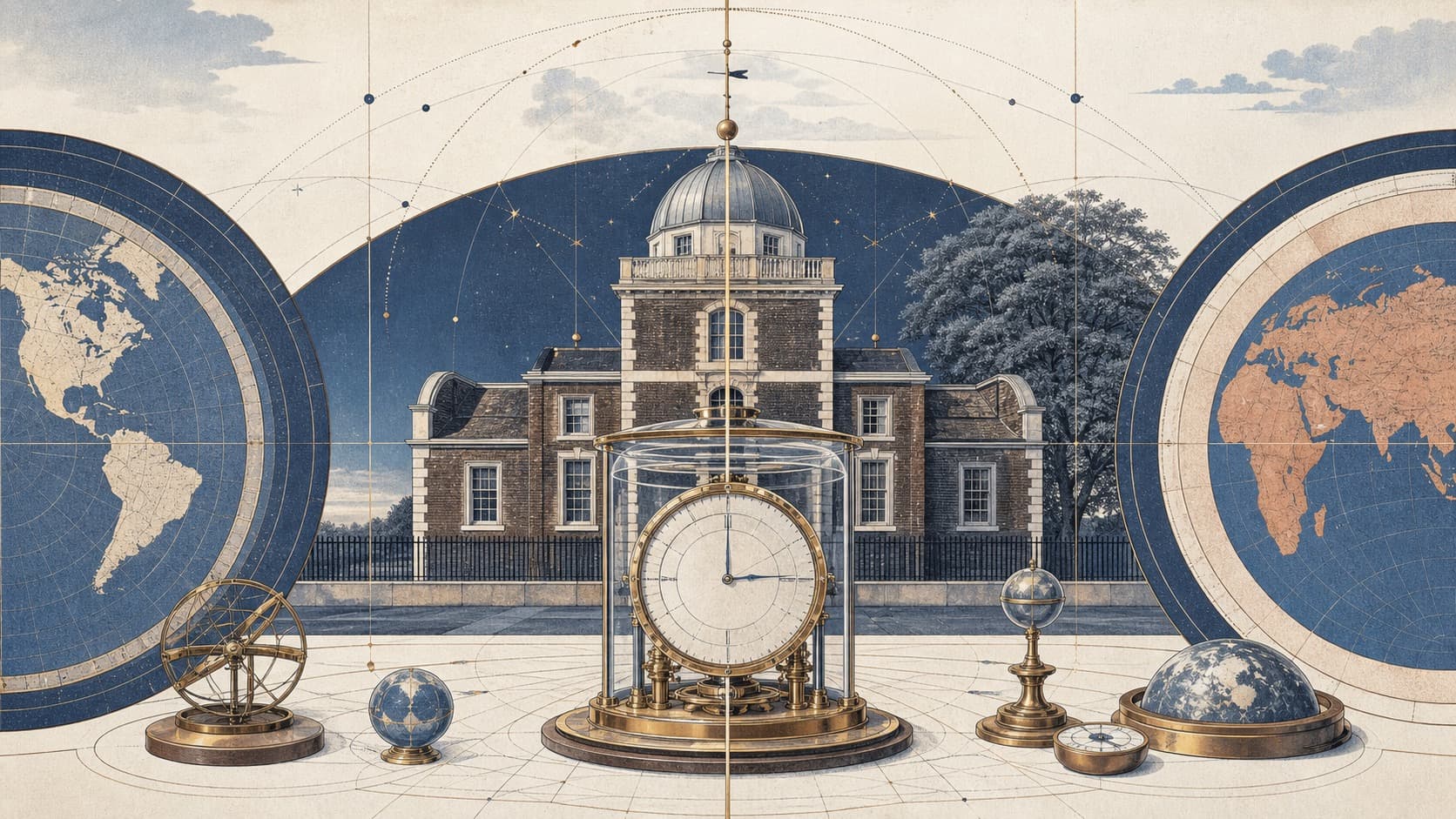
People use "UTC" and "GMT" as if they were the same thing. In casual conversation that's usually fine — but technically they are different, and the distinction matters.
Greenwich Mean Time (GMT)
GMT originated at the Royal Observatory in Greenwich, London. It is based on astronomical observation — specifically, the position of the Sun relative to the Greenwich meridian. When the Sun is at its highest point over Greenwich, it is noon GMT.
GMT became the world's time reference in the 19th century because Britain dominated global trade and navigation.
Coordinated Universal Time (UTC)
UTC, established in 1960 and refined in 1972, is based on atomic clocks rather than the Earth's rotation. Hundreds of atomic clocks around the world contribute to a weighted average that defines the official second.
UTC is far more precise than GMT — accurate to within nanoseconds, while the Earth's rotation is slightly irregular and gradually slowing.
The Key Difference
- GMT is a time zone (used by the UK in winter)
- UTC is a time standard — the baseline from which all time zones are defined
UTC never observes Daylight Saving Time. The UK, by contrast, shifts to British Summer Time (BST, or UTC+1) in summer, so GMT and UK local time only coincide in winter.
Leap Seconds
Because atomic time and astronomical time drift apart, leap seconds are occasionally added to UTC to keep it within 0.9 seconds of the Earth's actual rotation. GMT, being purely astronomical, needs no such correction.
Which Should You Use?
For computing, science, aviation, and any precise application, use UTC. For everyday British timekeeping, "GMT" is the familiar term. The offset is identical (UTC+0), so for most practical purposes they're interchangeable — but now you know why a scientist would insist on UTC.