Why Does a Year Have 365 Days?
The fascinating astronomy and history behind our 365-day calendar year.
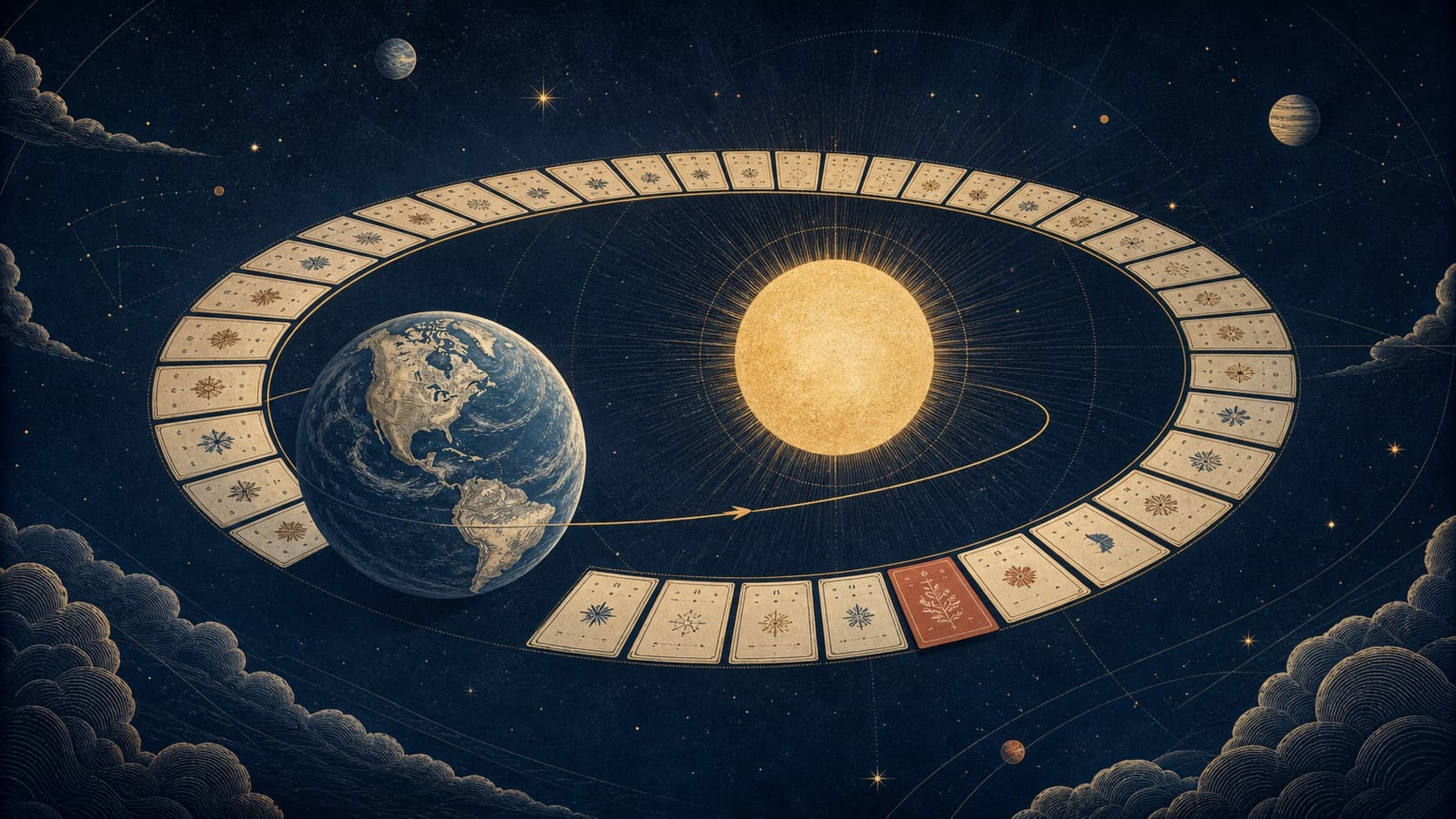
The Earth takes approximately 365.2422 days to complete one orbit around the Sun. This is called a tropical year — the time it takes for Earth to go from one vernal equinox to the next.
The Problem With 365.2422
You can't have 0.2422 of a day on a calendar, so ancient civilizations had to make a choice: round down to 365, or find a clever solution.
The ancient Egyptians used a 365-day calendar, but over centuries, this caused the calendar to drift out of sync with the seasons. A festival meant for harvest time would slowly slide into spring.
Julius Caesar's Solution
In 46 BCE, Julius Caesar worked with the Egyptian astronomer Sosigenes to reform the Roman calendar. Their solution: add an extra day every four years — what we now call a leap year.
With 365.25 days on average (three years of 365 days plus one year of 366 days), the calendar became much more accurate. This Julian calendar served Western civilization for over 1,500 years.
The Gregorian Refinement
The Julian calendar had one flaw: the tropical year isn't 365.25 days — it's 365.2422. That tiny difference of 0.0078 days per year adds up to about 3 days every 400 years.
By the 1500s, the Julian calendar had drifted 10 days ahead. Pope Gregory XIII commissioned a reform, leading to the Gregorian calendar in 1582. The fix: century years (1700, 1800, 1900) are not leap years unless they're divisible by 400 (like 2000).
This gives an average of 365.2425 days per year — accurate to within 26 seconds of the true tropical year.
Why It Matters
Calendar accuracy affects everything from agricultural planning to religious festivals to international trade. The Gregorian calendar is now the global standard for civil use, though many cultures maintain their own traditional calendars alongside it.
The next time you see "365 days" on a calendar, remember: that simple number represents thousands of years of astronomical observation, mathematical refinement, and political negotiation.