How Time Zones Work: The Complete Guide
From Greenwich Mean Time to UTC offsets — everything you need to know.
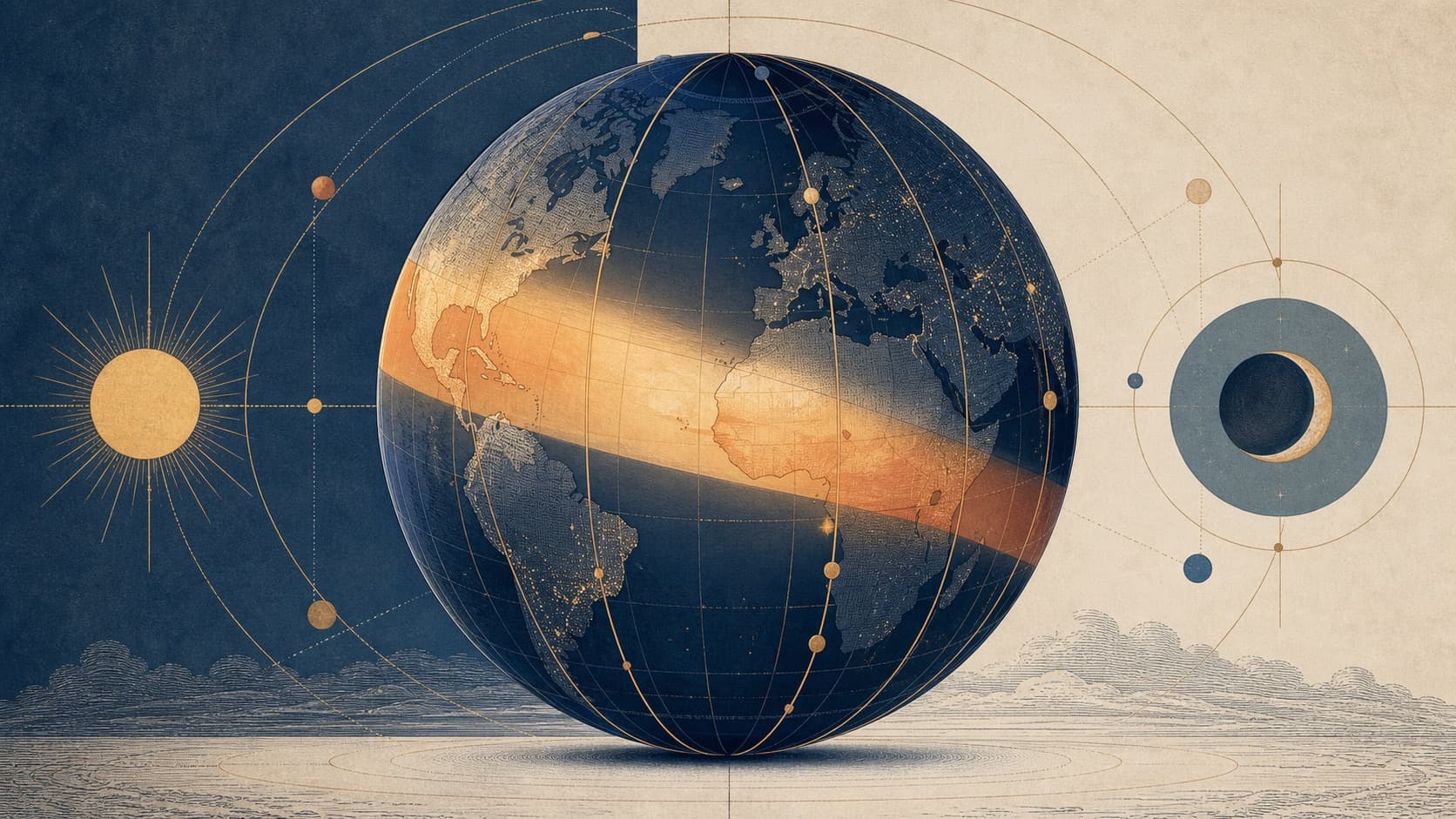
Before railways, each town set its clocks to local solar time — when the sun was highest, it was noon. This worked fine when travel was slow, but when trains started connecting cities at high speeds, chaos ensued.
The Railway Problem
In 1840s England, each railway station kept its own local time. A train leaving London at noon might arrive in Bristol — which was 10 minutes behind London time — at what Bristol clocks said was 11:50. Timetables were a nightmare.
The solution? Railway Time — setting all clocks along a railway line to the same time. By 1880, Britain had standardized on Greenwich Mean Time (GMT) nationwide.
The 1884 International Meridian Conference
With global telegraph networks connecting continents, the problem became international. In 1884, representatives from 25 nations met in Washington, D.C. to establish a global system.
They agreed on Greenwich, England as the Prime Meridian (0° longitude) — partly because British charts were already dominant worldwide and the Royal Observatory at Greenwich was the most prestigious.
From this prime meridian, the world was divided into 24 time zones, each roughly 15° of longitude wide (since Earth rotates 360° in 24 hours, that's 15° per hour).
UTC: The Modern Standard
Coordinated Universal Time (UTC) replaced GMT as the world's time standard in 1960. Unlike GMT, which is based on astronomical observations, UTC is based on atomic clocks — accurate to within nanoseconds.
UTC has no offset itself — all other time zones are defined as UTC+ or UTC- some number of hours.
Why Time Zones Are Messy
Political and economic considerations mean time zones rarely follow clean meridian lines: - China uses a single time zone (UTC+8) despite spanning 5 natural zones - India uses UTC+5:30 — a half-hour offset - Nepal uses UTC+5:45 — a 15-minute offset - Some regions observe Daylight Saving Time (DST), shifting clocks seasonally
This complexity is why time zone conversion tools exist — navigating the real world of time zones requires software, not just geography.