Lunar vs Solar Calendars: Key Differences
Why some calendars follow the moon, some the sun, and some try to track both.
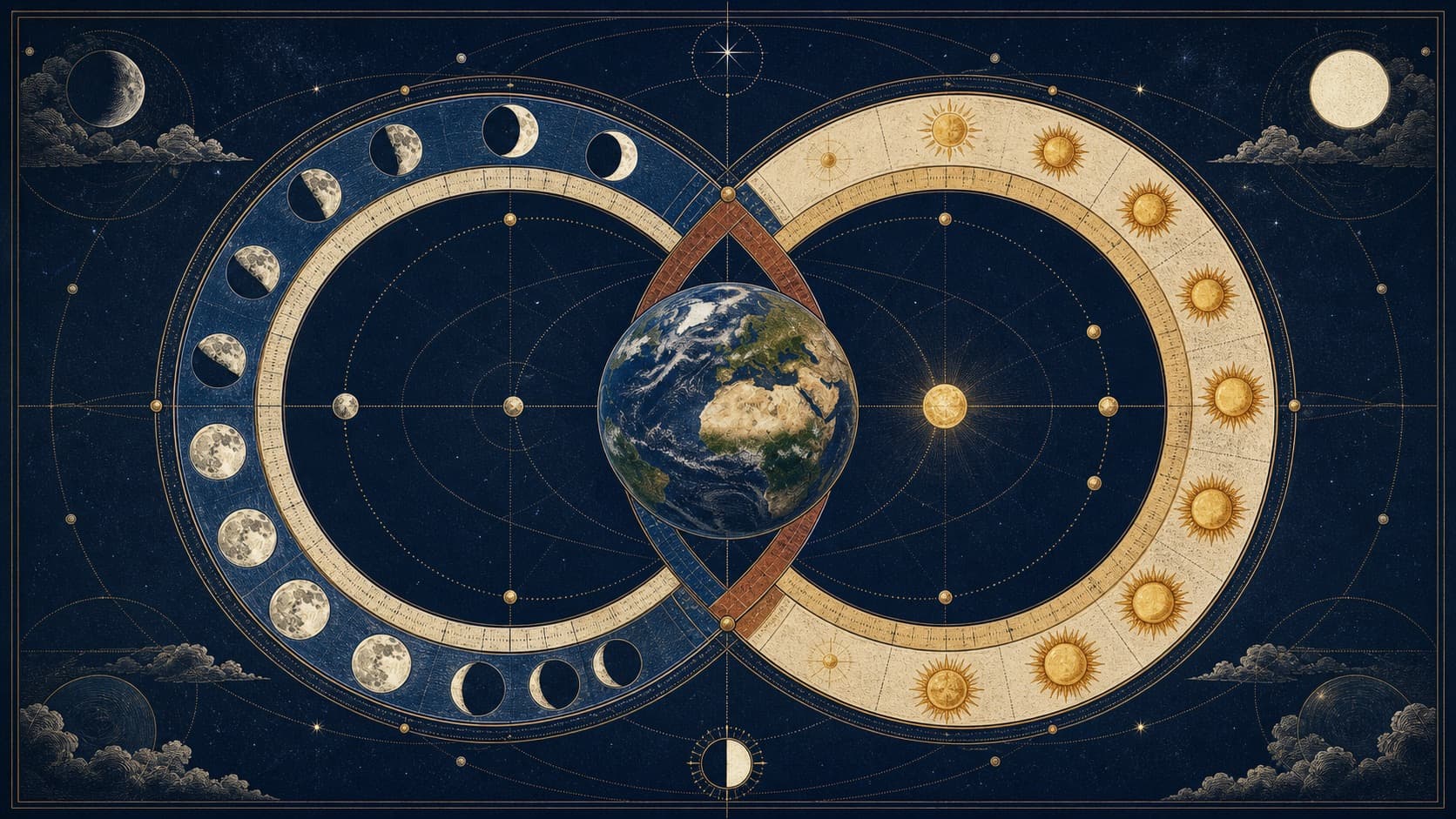
Every calendar humanity has built must answer one question: do we follow the Moon, the Sun, or both? That single choice shapes festivals, seasons, and daily life for billions of people.
Solar Calendars: Following the Sun
A solar calendar tracks the Earth's orbit around the Sun — the cycle of seasons. The year is about 365.24 days, and the Gregorian calendar used worldwide is solar. Its great strength: dates stay locked to the seasons. December is always winter in the Northern Hemisphere, year after year.
Lunar Calendars: Following the Moon
A lunar calendar tracks the phases of the Moon. Each month is one lunar cycle — about 29.5 days — giving a year of roughly 354 days, 11 days shorter than the solar year.
The Islamic (Hijri) calendar is purely lunar. Because it's 11 days short each solar year, its months drift through the seasons. This is why Ramadan can fall in summer one decade and winter another.
The Lunisolar Compromise
A lunisolar calendar tries to honor both. It keeps months tied to the Moon but periodically inserts a leap month to stay aligned with the solar year and seasons.
The Chinese, Hebrew, and Hindu calendars are lunisolar. This is why Chinese New Year and Jewish holidays land on different Gregorian dates each year, but always stay within the same general season.
Why the Differences Matter
The choice has real consequences: - Religious observance: when Easter, Ramadan, Passover, and Diwali occur depends on the calendar's structure - Agriculture: solar calendars are essential for knowing when to plant and harvest - Cultural identity: traditional calendars preserve heritage even where the Gregorian system dominates daily business
Two Ways of Seeing Time
Lunar calendars connect people to the visible, changing Moon — a clock anyone can read in the night sky. Solar calendars connect us to the steady march of the seasons. Lunisolar systems are humanity's attempt to have both. Each reflects a different answer to the oldest question: how do we make sense of time?