What Are Leap Seconds?
Occasionally we add a single second to the clock. Here's why — and why it may be abolished.
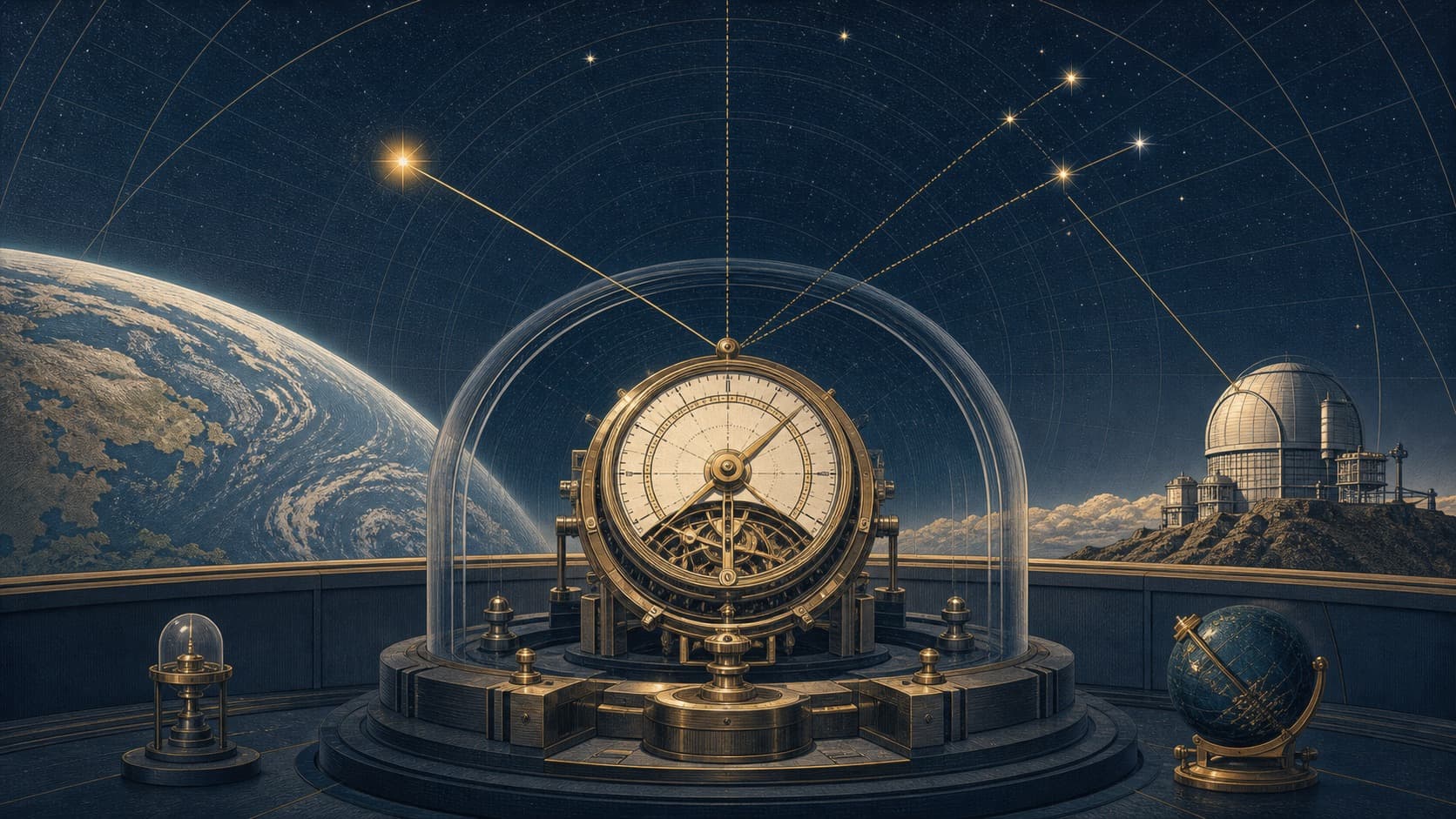
Every few years, the world's official clocks pause for a single extra second. This tiny adjustment — the leap second — quietly keeps atomic time aligned with the spinning Earth.
Why Leap Seconds Exist
We have two different ways of measuring time. Atomic time is based on the unchanging vibrations of atoms — perfectly steady. Astronomical time is based on the Earth's rotation, which is gradually slowing and slightly irregular due to tides, earthquakes, and the motion of Earth's molten core.
Over time, these two diverge. Atomic clocks run "too perfectly," getting ahead of the slowing Earth.
The Fix
To keep UTC within 0.9 seconds of the Earth's actual rotation, the International Earth Rotation Service occasionally inserts a leap second. When it happens, the last minute of a chosen day has 61 seconds: the clock reads 23:59:60 before rolling to 00:00:00.
Leap seconds are usually added on June 30 or December 31. Since 1972, 27 leap seconds have been added.
The Trouble They Cause
Leap seconds are a headache for computers. Many systems simply don't expect a clock to show :60. Major outages have been traced to leap seconds, affecting airlines, websites, and trading platforms.
Some companies use a "leap smear," spreading the extra second across many hours so no single moment jumps.
The End of Leap Seconds
In 2022, the world's metrology authorities voted to abolish leap seconds by 2035. Instead of frequent tiny corrections, the plan is to let UTC and astronomical time drift apart and make a larger adjustment only once every century or so.
The Bigger Picture
Leap seconds capture a deep truth: the universe doesn't run on neat numbers. Even our most precise timekeeping has to bend, occasionally, to the messy reality of a planet that doesn't spin quite evenly.