From Sundials to Smartwatches: A History of Clocks
The 5,000-year journey of humanity's quest to measure the passing of time.
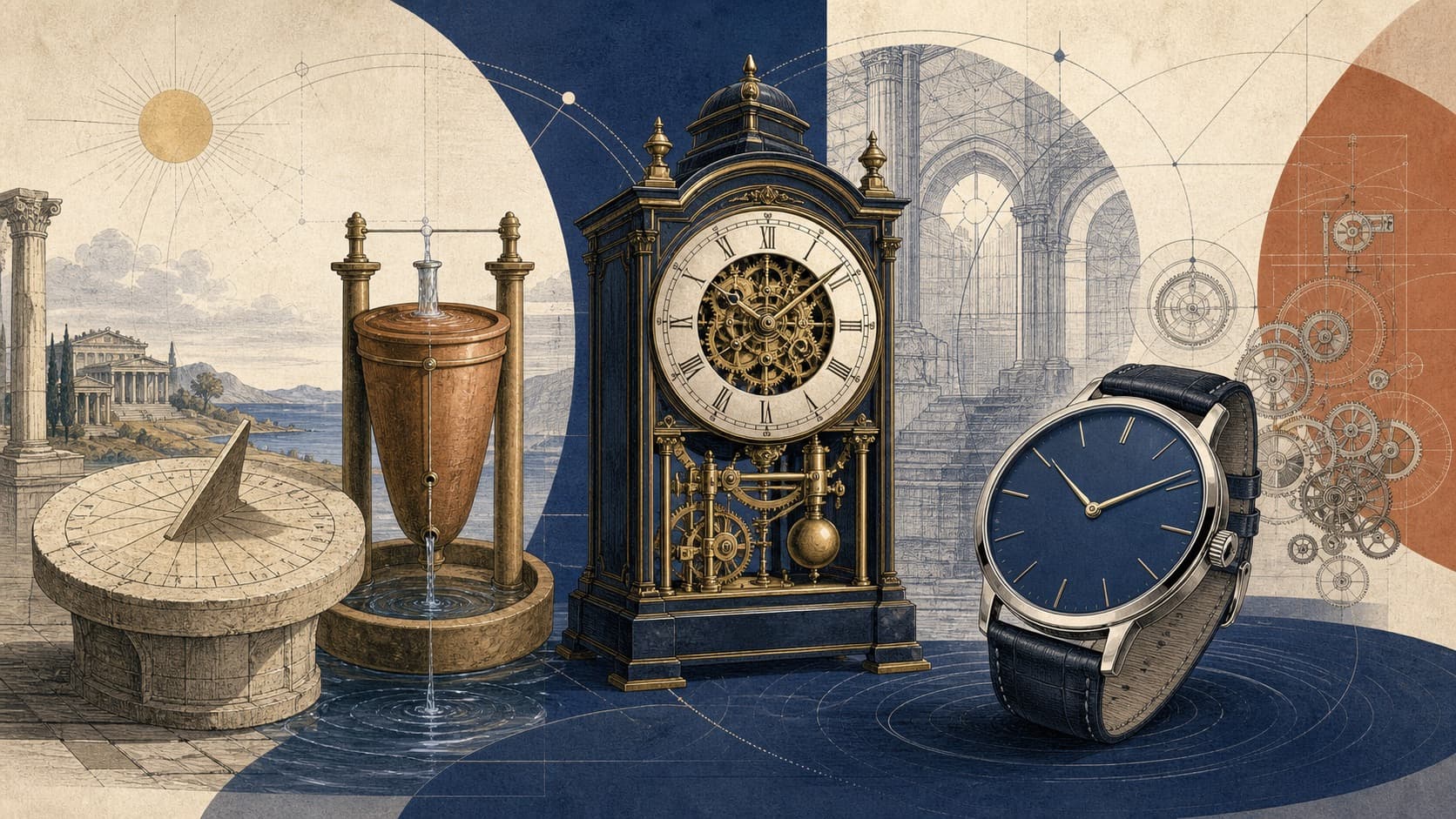
For most of human history, telling the time meant looking at the sky. The journey from shadow-casting sticks to atomic precision spans five thousand years of ingenuity.
Sundials and Shadow Clocks
The earliest timekeepers, used by the Egyptians and Babylonians around 1500 BCE, tracked the Sun's shadow. A sundial divides daylight into hours based on where a shadow falls. The obvious limitation: no sun, no time. Clouds and night left people in the dark, literally.
Water and Sand
To tell time without the Sun, ancient civilizations built water clocks (clepsydrae), which measured the steady drip of water from one vessel to another. The Greeks and Chinese refined these into elaborate mechanical marvels. Hourglasses, using sand, came later and were prized on ships where water clocks were impractical.
The Mechanical Revolution
The great leap came in medieval Europe, around the 14th century, with the mechanical clock driven by weights and regulated by an escapement — a device that releases energy in precise, ticking increments. These clocks appeared in cathedral towers, ringing bells to order daily life.
The Pendulum
In 1656, Dutch scientist Christiaan Huygens applied Galileo's insight that a pendulum swings at a regular rate. The pendulum clock was a hundred times more accurate than anything before it, losing only seconds per day.
Solving Longitude
Accurate clocks became a matter of life and death at sea. Sailors needed precise time to calculate longitude. In the 18th century, John Harrison's marine chronometers finally kept accurate time aboard rolling ships, saving countless lives.
Quartz and Atoms
The 20th century brought quartz clocks, using the steady vibration of a quartz crystal under electric current — the technology in most watches today. Then came the atomic clock, counting atomic vibrations with such precision that it now defines the second itself.
From Towers to Wrists to Pockets
Today the most accurate time in human history sits in everyone's pocket, synced automatically to atomic clocks via the internet and GPS. We've gone from squinting at shadows to carrying perfect time everywhere — a quiet revolution we barely notice.