A Brief History of Calendars
From lunar calendars to the Gregorian system — humanity's quest to track time.
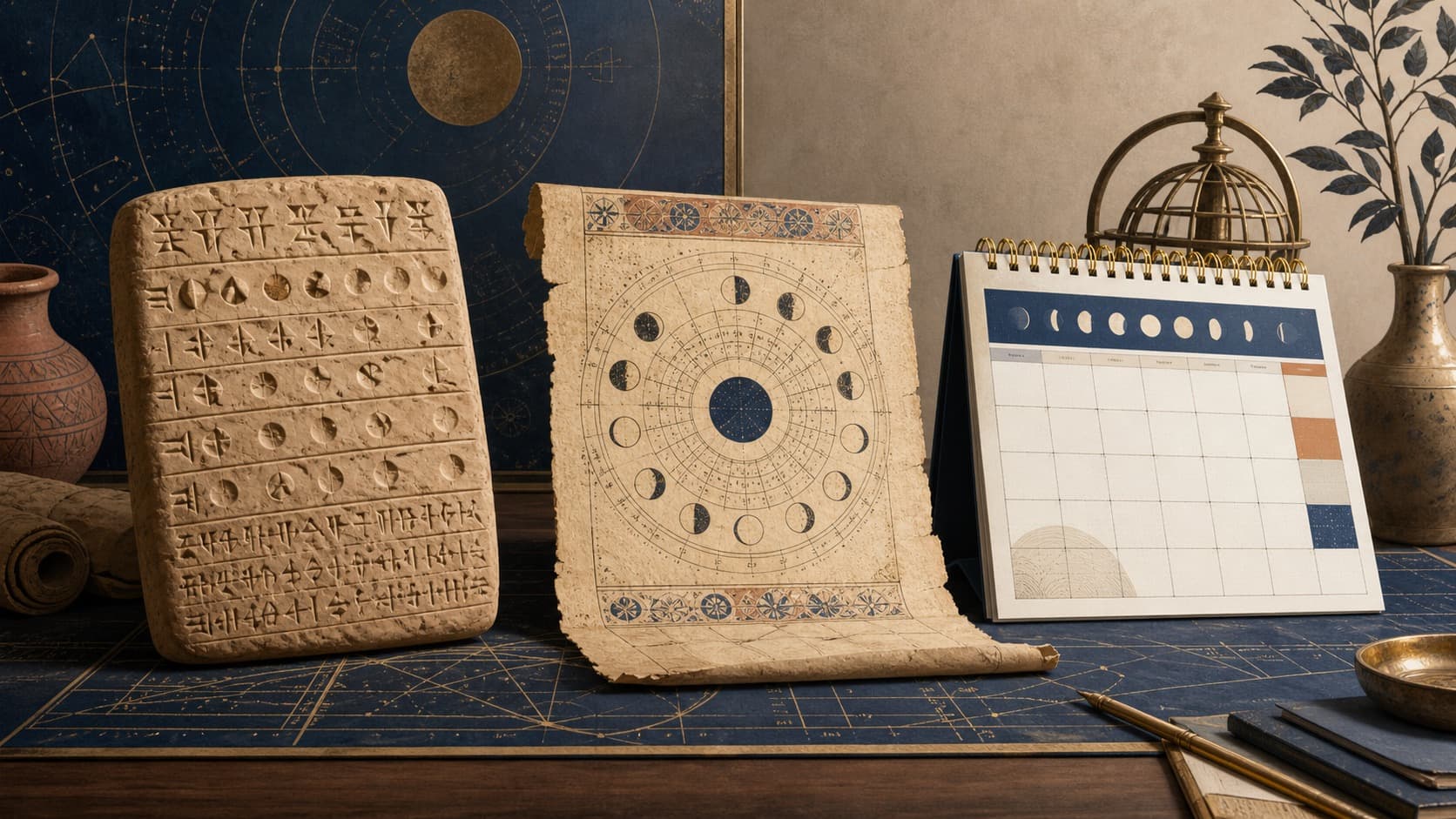
The calendar you use every day is the result of thousands of years of observation, politics, religion, and reform. Here's the story.
Lunar Calendars: The Beginning
The earliest calendars tracked the Moon, not the Sun. The Moon's cycle is easy to observe — new moon to full moon to new moon takes about 29.5 days. A lunar year of 12 months gives 354 days.
The problem: a purely lunar calendar drifts about 11 days per year against the seasons. The Islamic calendar remains purely lunar today — which is why Ramadan occurs at different seasons in different years.
Lunisolar Calendars: The Compromise
Many ancient civilizations developed lunisolar calendars — tracking lunar months but adding extra months periodically to stay aligned with the seasons.
The Hebrew calendar and Chinese calendar both use this approach, inserting a 13th month in certain years.
The Egyptian Solar Calendar
The ancient Egyptians were the first to adopt a purely solar calendar around 3000 BCE — 365 days, 12 months of 30 days, plus 5 extra days at year's end.
The Julian Calendar (46 BCE)
Julius Caesar's reform gave Rome a 365-day year with a leap day every four years. It remained in use for over 1,500 years.
The Gregorian Reform (1582)
By the 16th century, the Julian calendar had drifted 10 days. Pope Gregory XIII commissioned the reform. On October 4, 1582, Catholic countries went to sleep and woke up on October 15 — 10 days had vanished.
The Remaining Diversity
Despite the Gregorian calendar's dominance, traditional calendars remain culturally vital: - Chinese calendar: lunisolar, basis for Chinese New Year - Hebrew calendar: lunisolar, used for Jewish religious observance - Islamic calendar: lunar, used for Ramadan - Persian calendar: solar, considered the most accurate solar calendar in the world
Humanity's relationship with time is far richer than any single system can capture.