Why Do Some Time Zones Have Half-Hour Offsets?
Learn why India, Newfoundland, Nepal, and other regions use 30- or 45-minute UTC offsets instead of whole hours.
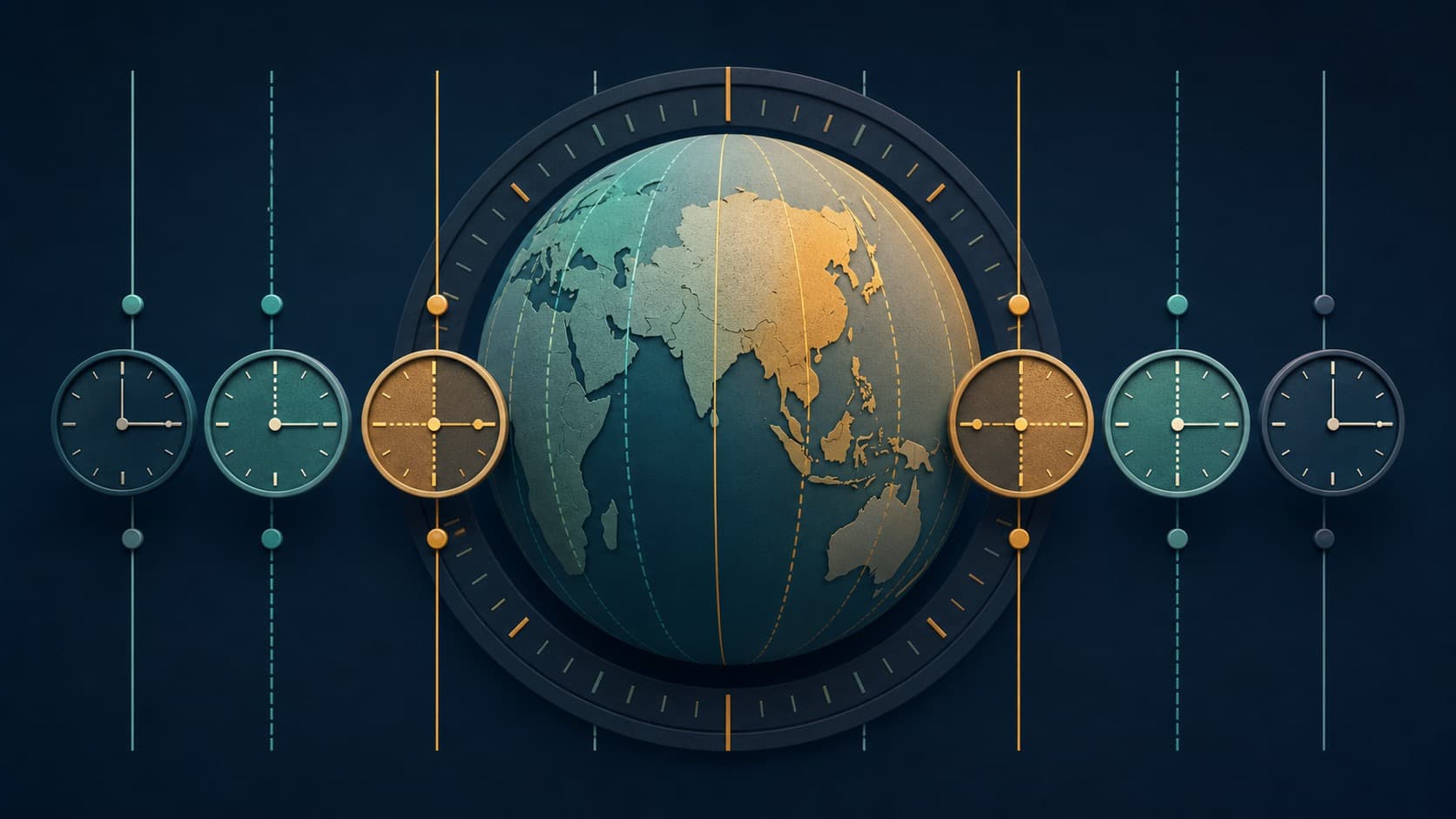
Some time zones use offsets such as UTC+05:30 or UTC+09:30 because civil time is a political and geographic choice, not a grid that must advance in whole hours. Half-hour and quarter-hour zones often preserve a region's preferred relationship with local solar time or distinguish it from a neighbor.
Longitude Does Not Divide Into Political Borders
Earth rotates 360 degrees in about 24 hours, which suggests 15 degrees of longitude per hour. That neat model creates idealized zones. Real countries and communities do not follow 15-degree strips, and governments are free to choose their legal time.
Before standard zones, towns used local mean solar time. Noon occurred when the sun crossed the local meridian. When railways and telegraphs encouraged regional standardization, many places chose an offset close to an important city's solar time. That offset did not always land on a whole hour.
India and UTC+05:30
India Standard Time uses UTC+05:30. The reference meridian is 82.5 degrees east, which corresponds to five and a half hours ahead of Greenwich at 15 degrees per hour. One national time also avoids internal clock changes across a geographically wide country, though sunrise varies substantially from west to east.
Newfoundland and UTC-03:30
Newfoundland's standard time reflects its position east of much of mainland North America and its own history of local standard time. The half-hour keeps local noon closer to the sun than a neighboring whole-hour zone would. Its seasonal daylight time is also expressed with a half-hour base.
Nepal and UTC+05:45
Nepal uses a quarter-hour offset, UTC+05:45. Quarter-hour zones prove that the modern system is not limited to 24 or 48 choices. The government selected a national standard that distinguishes Nepal and remains reasonably aligned with its longitude.
Other current non-whole-hour offsets include UTC+09:30 in parts of Australia and UTC+12:45 in the Chatham Islands. Some change seasonally, so a fixed list is not enough for future scheduling.
Why Software Must Use Real Zone Data
Assuming every offset is divisible by 60 minutes breaks valid timestamps. A time-zone selector also cannot be replaced by a list of current offsets. Regions can share an offset today and diverge after a daylight-saving transition.
Store named zones for recurring or future local events. Accept offsets with minute components in parsers and forms. When displaying a converted time, show both the city and its current offset if the audience spans regions.
Half-hour zones are not errors or incomplete versions of a whole-hour system. They are evidence that civil time developed through local geography, trade, identity, and law.
Offsets Can Change by Law
Governments have moved regions between whole-hour and fractional offsets, adopted daylight saving, and later reversed those choices. Historical conversion therefore needs the zone rule that applied on the event date, not today's offset copied backward.
The International Date Line is similarly irregular. It bends around political territories so one country or island group can share a civil date. Time-zone boundaries optimize administration and community ties as much as solar position.
Scheduling Across Fractional Zones
A meeting at 09:00 in a UTC+05:30 region appears at a half-hour mark in a whole-hour zone. Adding five hours and then forgetting the remaining 30 minutes is the classic manual error. Convert the complete offset in minutes:
- UTC+05:30 = 330 minutes ahead of UTC
- UTC+05:45 = 345 minutes ahead of UTC
- UTC-03:30 = 210 minutes behind UTC
Use a zone-aware calendar for recurring events. A numeric offset is enough for one known instant, but it cannot follow a region's future legal changes.