How to Read ISO 8601 Dates and Times
Decode ISO 8601 dates, UTC markers, numeric offsets, fractional seconds, and week or ordinal dates using practical examples.
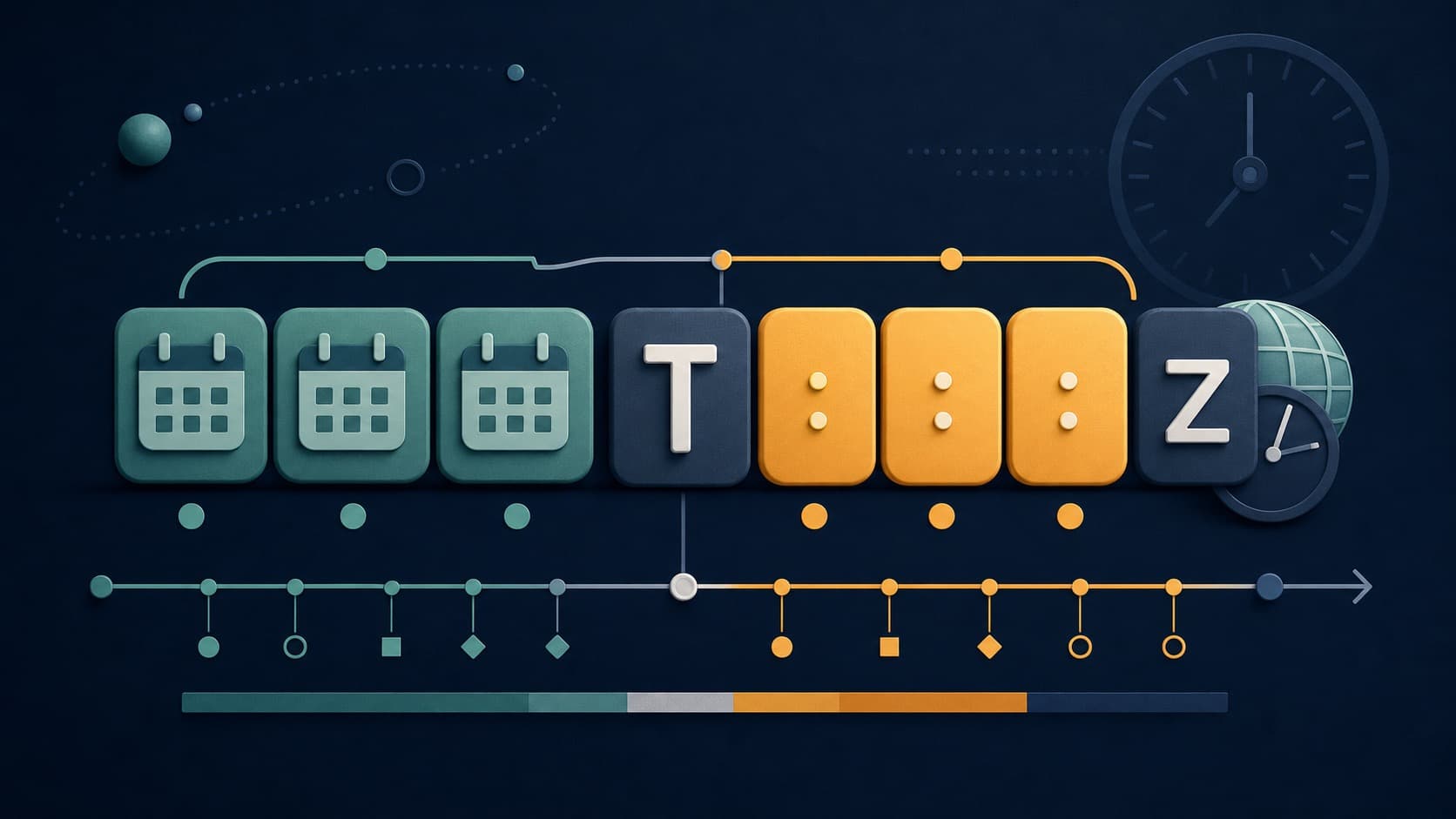
An ISO 8601 date puts the largest time unit first, so 2026-07-18 means 18 July 2026. A complete timestamp can add a time, fractional seconds, and a UTC offset. Reading the pieces from left to right removes most of the mystery.
Calendar Dates
The extended calendar form is YYYY-MM-DD:
2026-07-18means year 2026, month 07, day 182000-01-01means 1 January 20001582-10-15means 15 October 1582 in the stated calendar context
Fixed-width fields sort correctly as text when all values use the same form. That is one reason year-first dates work well in filenames, exports, and databases.
Date and Time Together
The letter T separates the date from the time. 2026-07-18T14:30:00 means 2:30 PM on that date, but it does not yet identify a unique instant because no offset is supplied.
RFC 3339, an internet timestamp profile based on ISO 8601, recommends including the relationship to UTC. Two common endings are:
Z, meaning UTC- A numeric offset such as
+05:30or-04:00
Thus 2026-07-18T14:30:00Z is 14:30 UTC. 2026-07-18T14:30:00+05:30 is a local reading five hours and thirty minutes ahead of UTC, equal to 09:00 UTC.
Fractional Seconds
Digits after the decimal point describe fractions of a second:
.1means one tenth of a second.123commonly represents millisecond precision.123456represents microsecond precision
Extra digits do not guarantee that the measuring device was accurate to that level. They show the precision of the representation.
Negative and Positive Offsets
To convert an offset timestamp to UTC, subtract a positive offset and add the magnitude of a negative offset.
2026-07-18T09:00:00-04:00 equals 13:00 UTC. The local clock is four hours behind UTC, so UTC is later.
An offset is not a complete time-zone rule. -04:00 does not say whether the location is New York, Santiago, or another region, and it cannot predict a future daylight-saving change.
Week Dates and Ordinal Dates
ISO 8601 also supports forms beyond month and day. 2026-W29-6 identifies day 6 of ISO week 29 in the ISO week-numbering year. 2026-199 identifies the 199th day of 2026.
These are useful in manufacturing, logistics, and scientific data, but a receiving system must explicitly support them. Do not assume every parser that accepts YYYY-MM-DD also accepts week or ordinal dates.
Common Parsing Mistakes
Treating a timestamp without an offset as UTC can shift an event by hours. Dropping the offset before storing a value has the same effect. A date-only value should remain a date if no time was intended; inventing midnight can move it to the previous date when displayed elsewhere.
For data exchange, choose one documented profile, include an offset for real instants, preserve fractional precision when it matters, and reject incomplete input rather than filling gaps silently.
Normalize Only After Parsing
Two strings can identify the same instant: 2026-07-18T14:30:00Z and 2026-07-18T20:00:00+05:30. Converting both to UTC makes comparison easy, but the original offset may still carry useful context. Preserve it when an audit trail needs to show what the sender supplied.
Do not normalize by editing characters. Parse the fields, validate the calendar date and offset, create an instant, then format the desired output. Character replacement can turn an invalid value into a different valid one.
Date-Only and Floating Local Values
2026-07-18 is a calendar date, not midnight UTC. A meeting written as 2026-07-18T09:00:00 without an offset is a floating local time unless the surrounding specification defines a zone. Birthdays and recurring store-opening times are often meant to remain local rather than represent one global instant.
Before converting, ask which kind of value you have: a date, a local wall time, or an instant. ISO syntax can represent all three, but software should not silently treat them as interchangeable.