How to Calculate Overtime Hours and Overtime Pay
Calculate weekly overtime hours and time-and-a-half pay with breaks, multiple rates, and workweek boundaries in mind.
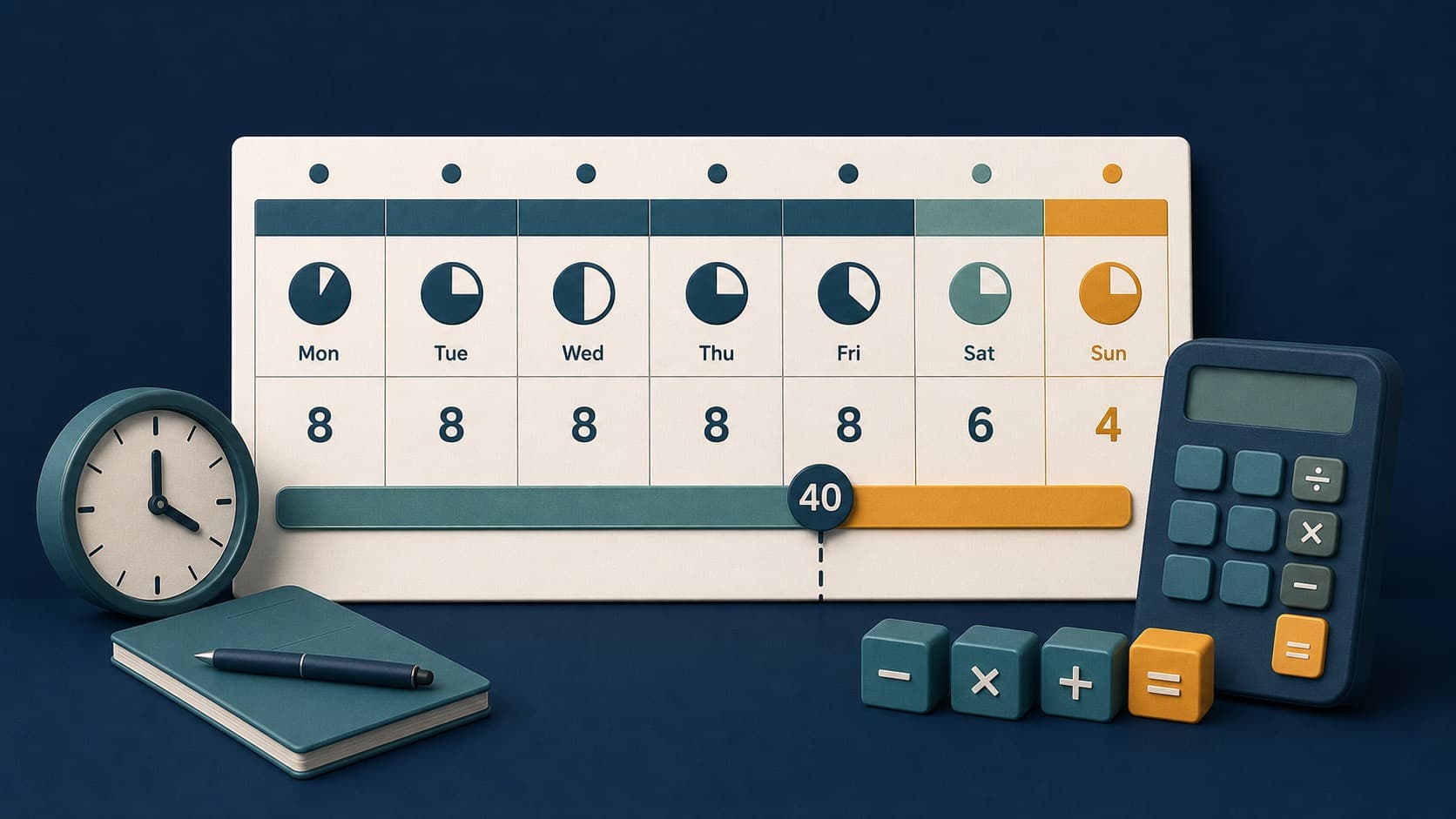
To calculate overtime hours, total compensable hours inside the defined workweek, then compare the result with the applicable threshold. For many nonexempt employees covered by U.S. federal law, hours over 40 in one workweek receive at least one and one-half times the regular rate. Local law, industry rules, contracts, and exemptions can change that answer.
Step 1: Identify the Workweek
Do not begin with the calendar page or pay period. The U.S. Department of Labor defines an FLSA workweek as 168 consecutive hours and notes that it can begin on any day and at any hour set by the employer.
Write down the precise boundary. A two-week paycheck can contain two separate overtime calculations. Under the general federal rule, a 35-hour week and a 45-hour week are not averaged into two 40-hour weeks.
Step 2: Total Hours Worked
For each shift, calculate elapsed time and subtract unpaid breaks. Add all compensable hours that fall within the workweek. Training, travel, on-call time, or pre-shift work may count in some circumstances, so a time calculator cannot determine legal compensability by itself.
Example weekly hours:
- Monday: 8.0
- Tuesday: 8.5
- Wednesday: 9.0
- Thursday: 8.0
- Friday: 10.0
The total is 43.5 hours. With a 40-hour threshold, straight-time hours are 40 and overtime hours are 3.5.
Step 3: Find the Regular Rate
For a worker paid one hourly rate with no other includable compensation, the regular rate is usually that hourly rate. If it is $20 per hour, the overtime rate at time and one-half is $30 per hour.
Weekly pay in the simple example is:
- 40 × $20 = $800 straight time
- 3.5 × $30 = $105 overtime
- Total = $905
Bonuses, commissions, multiple rates, piecework, and certain salary arrangements can change the regular-rate calculation. The Department of Labor's guidance explains that some payments must be included. Use payroll or legal guidance when the pay structure is not a single hourly rate.
Daily Overtime and Special Rules
Federal law does not generally create overtime merely because work occurs on Saturday, Sunday, or at night. Some states, industries, and agreements do require daily overtime, seventh-day premiums, or shift differentials. Calculate those under the relevant rule and avoid paying the same premium twice unless the rule requires it.
Decimal Hours
Convert minutes by dividing by 60. Fifteen minutes is 0.25 hours, not 0.15. Keep enough precision during calculation and apply the employer's lawful rounding rule only at the specified step.
Audit the Result
Check that every shift belongs to the correct workweek, every unpaid break was subtracted once, and no day was omitted at a pay-period edge. Preserve the original clock-in and clock-out records beside the decimal total. This article gives a general calculation method, not a determination of coverage or legal entitlement.
Multiple Hourly Rates
An employee may perform two jobs at different rates during one workweek. The regular rate may need a weighted average rather than whichever rate applied when the overtime hour occurred. For example, 30 hours at $20 and 12 hours at $25 produce $900 of straight-time earnings across 42 hours, a weighted rate of about $21.43 before applying the required overtime premium under the applicable method.
Contracts or laws can authorize other calculations. Retain hours and earnings by rate instead of collapsing them too early.
Rounding and Time Records
Rounding each clock punch can produce a different answer from rounding the final weekly total. A policy should be lawful, neutral in practice, and applied consistently. Keep the raw punch times so corrections can be audited.
When a total is disputed, rebuild it from the source records in this order: place punches on a timeline, identify the workweek boundary, mark compensable intervals, subtract unpaid breaks, group hours by rate, and only then calculate premiums. That sequence separates timekeeping errors from pay-rate errors.